
Golfer's elbow (Medial epicondylalgia)
Why do people get golfer's elbow (medial epicondylalgia)?
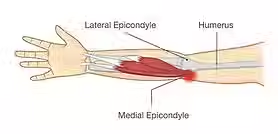
Golfer's elbow (medial epicondylalgia) is an overuse injury on the inside of the elbow. It occurs either gradually from unilateral, low-intensity strain on a tendon attachment on the inside of the elbow, for example if you carry a lot in your hand such as grocery bags, a computer bag or from playing golf. It can also occur after heavier work such as carpentry, moving work, strength training. Previously, this diagnosis was called medial epicondylitis, which indicates inflammation. This is misleading, as you normally cannot see any inflammation in the painful area. The name has therefore been changed to epicondylalgia, which instead indicates pain in the area. Less than 5% of the population is affected and it is most common to get this between the ages of 45-54.
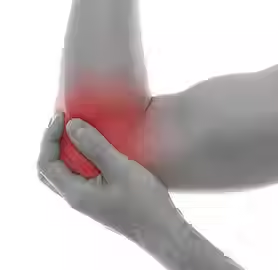
Symptoms of lateral epicondylalgia
Pain on the outside of the elbow when straining. Usually, there is no pain at rest. The pain can radiate down the forearm and back of the hand. You may have pain at night or in the morning if you have been lying down with your arm/hand in a bad position and the tendon attachment has been stretched for a long time. There is a well-defined tenderness on the bony prominence on the outside of the elbow. It is not uncommon for the muscles in the forearm to also be sore. Sometimes the forearm/hand is felt to be weak.
Treatment for golfer's elbow
First and foremost, rest or minimize the activity that caused golfer's elbow (medial epicondylalgia), if you can figure out what it was.
The most important goal in the treatment of golfer's elbow is to increase load tolerance in the painful tendon attachment on the inside of the elbow. This is best done through eccentric training of the muscles on the inside of the forearm. This means that loading occurs in the phase when the muscle works in extension, slowing down the movement. As long as the symptoms do not generally worsen, it is okay for it to hurt a little during training. The training is initially performed once a day and as the load increases, the training sessions are reduced to every other day. Instruction and optimization of the load are done together with your physiotherapist.
This training is often combined with shockwave therapy. This is to speed up healing in the area. We can perform this treatment at Alta Vita Physiotherapy. It hurts a little when you get this type of treatment, but we always adapt the treatment to what the patient thinks is manageable.
If the treatment does not lead to improvement, or if the intensity of the pain is intense, this can be investigated further with us using ultrasound diagnostics. Then we can see to what extent the tendon attachment in the elbow is affected, what the rest of the area looks like and in this way hopefully be able to clarify why the treatment is not progressing.
Prognosis for medial epicondylitis
In many cases, this problem heals even without treatment and exercise. However, if you do not perform the exercise we recommend, there is a high risk that the problem will return when you put pressure on this area again. For a few patients who do not get better despite well-executed rehab, surgery may be necessary.

