Snapping hip
What is snapping hip?
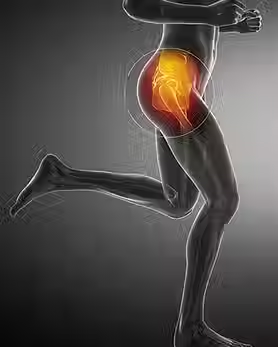
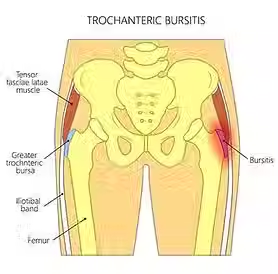
There are three different types of snapping hip. We will describe the most common type. In this case, it involves a tendon, the IT band (tractus iliotibialis), which is located on the outside of the hip and extends down the thigh to the outside of the knee. The IT band passes over the tubercle of the femur, the greater trochanter, which is located on the outside of the hip. Under load, when the leg is moved forward and backward, such as when walking or running, the tendon slides taut over the greater trochanter and snaps past it, and the patient experiences a snapping sound. It is not uncommon to hear the sound when it happens. Some people experience that it feels as if the hip is about to dislocate but snaps back into the correct position, but that is not what happens.
Approximately 10% of the population is affected by this. It seems that it is more common for women to be affected. This is an overuse injury that usually affects athletes in sports such as running, handball, football, dance, athletics. Weakness in the hip abductors that are located on the outside of the hip, hypermobility, pronation in the foot insertion (the foot falls inward when loaded) are other factors that increase the risk of snapping hip.
Symptoms of snapping hip
Just as the name suggests, this condition is primarily characterized by a snapping sensation on the outside of the hip when under load when walking, running or other specific movements. Often, pain is not a problem initially, but rather the most discomfort is when the snapping sensation occurs on the outside of the hip. If this is allowed to continue without treatment, irritation can occur in the friction area between the tendon and the greater trochanter and pain occurs when under load. The tendon can become irritated and thickened, and a sac of mucus that cushions between the tendon and the bone can become irritated and cause pain.
Treatment for snapping hip
It is important to identify what may be the cause of snapping hip and reduce any activity to calm the area. If you pronate, we recommend anatomical shoe inserts in combination with stabilization training for the foot/ankle. The patient often receives shock wave treatment on the outside of the hip and buttock in combination with circulation and strength training for the hip, thigh. If the patient runs, a running analysis is performed to optimize the running stride so that we minimize the risk of relapse when running is gradually resumed.
If there is no improvement, the patient is examined with ultrasound diagnostics to see if only the tendon is affected or if the bursa is also irritated. If there is an impact there, we can offer an ultrasound-guided cortisone injection into the bursa in an attempt to relieve the pain. This is always done in combination with other treatment/rehabilitation.
Forecast
With treatment and rehabilitation training in combination with a patient who follows the instructions well, the symptoms usually subside after about 6-8 weeks. If there is no improvement, the patient is referred to an orthopedist for a decision on possible surgery. However, it is unusual that we need to refer the patient further and even more unusual that surgery is performed.