Shoulder dislocation - Dislocated shoulder
What is shoulder dislocation?
The shoulder joint has amazing mobility. As a result, it is also a little more unstable than joints with less range of motion and there may be a risk of the shoulder dislocating.
The ball of the upper arm is significantly larger than the joint surface of the shoulder blade that it leads into. The fact that the joint is not so enveloping around the ball of the upper arm allows for the fine mobility that exists in the joint. But this is also why there is a risk of shoulder dislocation. Around the edge of the joint surface of the shoulder blade is a cartilage ring, the Labrum glenoidale, which increases the contact surface between the joint surfaces and improves stability. In addition, there are a number of ligaments that passively contribute to stabilizing the area. Outside of this, there is a set of muscles around the joint, the Rotator cuff, whose main task is to actively control the upper arm so that the ball of the joint is centered in the shoulder joint.

If the shoulder dislocates, it almost always does so forward in the joint. Most often, it happens in a sudden movement when the arm is rotated outwards/backwards under load. This can happen, for example, in a fall, or if you get caught by an opponent during a throw (think handball, basketball). If this happens, the cartilage ring, the Labrum, is usually damaged and partially detaches from the joint edge. The fact that the Labrum is damaged is one reason why it can be easy to suffer the same injury again after a dislocation. This is called a Bankart injury (after an orthopaedic surgeon who noticed this in the 1920s). Approximately 50% of those who suffer a shoulder dislocate also have a joint surface injury on the back of the ball of the upper arm. This happens when the ball of the joint hits back against the joint edge with force just after the dislocation when the muscles in the shoulder/shoulder spasm.
There are more protective structures at the back of the shoulder, which makes it unusual for the shoulder to dislocate that way (only 5% of shoulder dislocations). It takes more force in the accident for it to happen, for example a car accident or high-speed ice skating.
When it comes to the shoulder, this is one of the most common injuries. Of those injured, 85% are men and the majority are aged 20-30. This most often happens in connection with sports.
Symptoms of shoulder dislocation
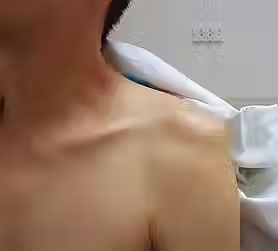
In the acute situation, these patients are usually significantly affected by pain and have cold sweats with pain in the shoulder. If the person has had several dislocations before, the pain may be significantly milder. In the more painful cases, it is common for them to hold their arm slightly away from the body and relieve/protect the injured arm with the healthy arm. Visually, the shoulder has a different shape than the other side. It looks like there is a small step from the edge of the shoulder blade on the outside of the shoulder down to the upper arm. We check to make sure there is a pulse at the wrist so that the vessels in the shoulder do not stop the blood flow out into the arm/hand. Most often, mobility is significantly impaired. The patient is not interested in trying to move the arm at all. There are a few different ways to gently try to get the upper arm back into the correct position (this is called reducing the shoulder). However, many patients are so affected by pain that it is not even possible to try. Then all you have to do is make sure that they get medical attention as soon as possible where painkillers can be given before reduction can be performed.
Something to be aware of here is that in a fall or if you hit your shoulder, the ligaments in the clavicle joint on top of the shoulder can loosen and the clavicle can stand up under the skin. It can then look a bit like a shoulder dislocation. However, these patients are rarely as affected by pain and it is possible to move the arm more. Even a rotator cuff tear, a fracture of the upper arm can cause similar symptoms.
Treatment for dislocated shoulder
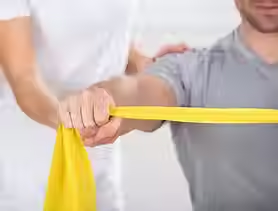
After reduction, the arm is placed in a shoulder lock or sling for a few days. After that, careful rehabilitation of the shoulder can begin. We then begin by conducting an examination of the shoulder to get a sense of the current starting position. Passive movement training for the shoulder is begun. Exercises for the forearm/elbow are also instructed. Rehabilitation training is then gradually increased depending on how the shoulder responds to the training. The rehabilitation period is around 3 months, but can vary from case to case. The goal of rehabilitation is equal-sided mobility and strength in the shoulder and that the patient does not experience the shoulder as unstable. If the shoulder “just” almost dislocated, subluxated, as it is called, the rehabilitation looks almost the same, but you can usually start training at a higher level. If we suspect an injury to the rotator cuff, we perform ultrasound diagnostics on the shoulder.
Forecast
The prognosis is considered relatively good. Especially if you undergo guided rehabilitation. If you have dislocated your shoulder and it is the first time it has happened, the risk of it happening again is 30%. The risk increases if you are young when it happens. If the shoulder dislocates repeatedly and the shoulder is experienced as unstable, surgery may be necessary. During the surgery, damage to the labrum and ligaments is repaired. Of those who have undergone surgery, approximately 90% survive new dislocations.