
Achilles tendon
Achilles tendon pain
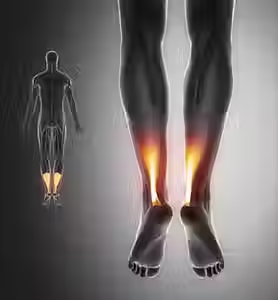
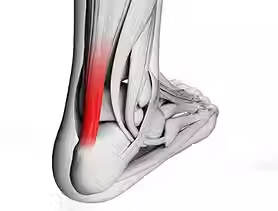
Medical terms for this are Achilles tendinopathy, Achilles tendinosis and Achilles tendinitis. Pain in the Achilles tendon is a common overuse injury. The pain can be located down at the attachment of the heel bone or a bit up the tendon. Sometimes you can see and feel a tender thickening of the tendon. There is rarely any active inflammation in the tendon. Instead, it is a number of small injuries to the tendon that lead to the pain. For many, blood vessels also grow into the tendon (hypervascularization). There are nerves in all vessels and when there is a pull on the Achilles tendon when strain is applied, these can also lead to pain in the Achilles tendon. For us, it is initially important to make sure that the tendon is not partially ruptured (ruptured). At Alta Vita Physiotherapy, we have access to ultrasound diagnostics with which we can ensure this. With it, we can also see the degree of impact on the tendon, so that the physiotherapist can more easily start with adequate treatment and rehabilitation training at the right level.
.avif)
Why do people get hamstring problems?
The most common reason for Achilles tendon pain is that it has been overused. Often it is due to some type of training that involves running and/or jumping. This may be because you have increased the training intensity or duration too quickly, with too little rest between training sessions. Other causes may be a change in shoes or a change in the surface on which the training is carried out.
Symptoms of Achilles tendinosis
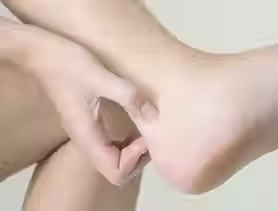
Pain/soreness in the Achilles tendon during exertion such as when jumping, running or walking. Increased stiffness/pain in the Achilles tendon in the morning and when standing up after sitting for a while is common. If you press on the tendon, it is tender. Sometimes very local, sometimes more widespread over the tendon. Sometimes you can feel a “crunching” if you hold the tendon and move your foot at the same time. This may be a sign of inflammation in the tendon sheath (peritendinitis) that surrounds the Achilles tendon. This is best treated by a doctor.
Treatment of the Achilles tendon
Normally, we recommend resting from the activity that is likely to have caused the pain. In the examination, we look at, among other things, the mobility of the ankle. We also look at the foot position, as pronation (the foot falling inwards when loaded) can contribute to this problem. We often start with eccentric toe raises (loading in the negative phase of a toe raise, on the way down) for the Achilles tendon. This is combined with shock wave treatment to speed up healing. Rehabilitation training is clearly the most important thing to regain and increase the strength of the Achilles tendon, but shock wave treatment usually helps to shorten the rehabilitation period. To optimize the foot position, a trial for anatomical shoe inserts can also be done. If you are a runner, a medical running analysis can be carried out to optimize the running stride so that the load on the Achilles tendon is kept low.
The prognosis for Achilles tendinopathy?
It is good, but it can take time even with optimal treatment. How long it takes, however, depends on how extensive the damage to the tendon is. However, after about 12 weeks, you usually experience a significant improvement.

Other possible diagnoses
Retrocalcaneal Achilles bursitis: At the front of the heel bone where the Achilles tendon attaches, there is a bursa and it can become inflamed, known as bursitis. Shoes where the heel cap presses against the Achilles tendon can trigger problems in this area. If you have these problems, deep toe raises often cause more problems and then we do not recommend eccentric toe raises.
Subcutaneous Achilles bursitis: This bursa is located at the back of the heel bone and can become inflamed with prolonged pressure on the heel.
Haglund's disease: In this injury, the heel bone loosens and a growth forms on the heel bone. If this growth becomes significant, surgery may be necessary.
We physiotherapists at Alta Vita Physiotherapy can use ultrasound diagnostics to verify which of these diagnoses it is.
