
Jumping knee
What is hopping knee?
Different medical terms for jumper's knee include patellar tendon tendinosis, patellar tendon tendinopathy or apicitis. The large quadriceps muscle group is located on the front of the thigh. The tendons from its four muscles join together in a strong tendon, in which the kneecap (patella) is embedded in the middle. The tendon then attaches high up on the lower leg, the tibia. Jumper's knee is an overuse injury to this tendon, the patellar tendon. Small tears occur, usually in the transition between the kneecap and the tendon at the lower edge of the kneecap. This can also occur at the upper edge of the kneecap, but is far from as common.
.avif)
Why do you get hopping knees?
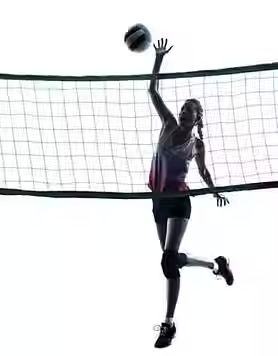
This is common in sports that involve a lot of jumping, starting and stopping, and sudden changes of direction, such as basketball, volleyball, and soccer. It can also occur in people who start running too intensively. However, it most commonly affects people who play sports at a high level. Our physiotherapists look at internal and external factors that may be the cause of this injury.
Examples of internal factors are:
Foot position, pronation (flat feet) can contribute to this problem.
Insufficient strength in the legs, especially in the front of the thigh, in relation to the activity the person is performing.
Patellar tendon quality
Examples of external factors are:
Too drastic an increase in intensity or duration of an activity.
Too little rest (in this case the patellar tendon) between training sessions.
Changing the surface on which the activity is performed.
Running technique with potential for improvement.
Symptoms of jumping knee?
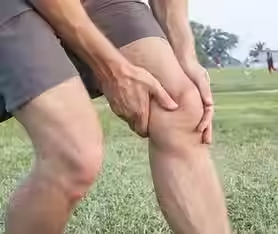
Local pain in the front of the knee, especially at the lower edge of the kneecap. Some people may have more pain and feel increased stiffness in the tendon in the morning or if they have been sitting with their knee bent for a long time. A number of different classifications have been made to try to grade the extent of the injury in jumper's knee. Here is an example:
Grade 1 – Pain after activity.
Grade 2 – Pain occurs at the beginning of an activity and, when the knee warms up, it returns after the exercise is finished.
Grade 3a – Pain is now present during warm-up, during activity, and afterwards. At this level, exercise can be continued unchanged.
Grade 3b – Same symptoms as grade 3, but now you can no longer continue exercising at the same level as before the onset of pain. Here, you often have rest pain in the area.
Grade 4 – The tendon breaks, ruptures.
Ultrasound diagnostics give us a clear picture of how affected the tendon is, which gives the physiotherapist valuable information about how tough he/she can be initially in rehabilitation training.
How is jumper's knee treated?
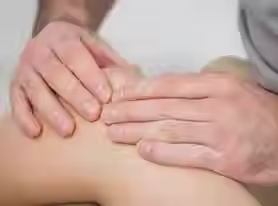
The patient should, during part of the rehabilitation, refrain from the activity that was the basis for the injury. The purpose of the rehabilitation is to achieve healing in the tendon and gradually increase the load in the training to increase the load tolerance in the patellar tendon. We at Alta Vita physiotherapy often treat this diagnosis with a combination of shock wave therapy and eccentric training. Shock wave therapy to speed up the healing of the tendon.
Eccentric training means that the focus is placed on the braking phase of a loaded movement, that is, the part of the movement when the muscle is working during extension. In this phase of the movement we have approximately 40% more force compared to when the muscle is working during extension, the concentric phase. Rehabilitation training starts at a level that does not trigger increased pain in the tendon and is gradually increased to become a significant load on the tendon, so that it can withstand the activity the patient wishes to perform.
If the injury is extensive and the patient intends to return to previously heavy-duty activities, such as high jump, long jump, volleyball, surgery may be necessary in some cases.
.avif)
