Knee osteoarthritis
What is knee osteoarthritis (arthritis of the knee)?
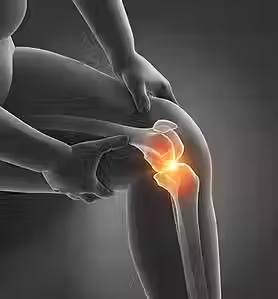
The knee joint consists of the femur and the lower leg. The joint ends have a surface coating of cartilage, which is responsible for providing stability and sliding ability to the joint. When we put pressure on a joint, the cartilage wears out. The body is constantly working to maintain the cartilage. In osteoarthritis, maintenance is not in balance with wear and tear, and the cartilage then becomes thinner and often uneven. Over time, bone deposits form around the edge of the joint, which contributes to reduced mobility. It is a bit unclear why we get osteoarthritis. It can be seen that genetics play a role, so if your mother or father has/had osteoarthritis, the risk is increased. Being overweight and inactivity are also risk factors for getting knee osteoarthritis (arthritis of the knee). Likewise if you have previously injured your knee, for example meniscus damage, cruciate ligament damage or had a fracture that reached into the joint. No gender difference can be seen. Most people who suffer from osteoarthritis are over 45 years old and it is more common with increasing age. In everyday life, we often refer to this as wear and tear on the knee, but the medical term is gonarthrosis and is one of the most common places we get osteoarthritis.
Symptoms of knee osteoarthritis
Common symptoms at the beginning of knee osteoarthritis (arthritis of the knee) are pain when standing and walking. You often have increased stiffness and pain in the morning, which can decrease after a while when you get going. By far the most common is that you get pain on the inside of the knee. Other common symptoms are swelling and increased heat in the knee. The knee may crack when you sit down/stand up, for example. The problems often come in waves. Either linked to putting too much strain on the knee, and sometimes even without a clear cause. Medically, we call it a flare-up of osteoarthritis.
There is no direct connection between how much trouble you have and how thin the cartilage is. Some people may have a lot of pain/stiffness but it is barely visible on X-ray. It is not uncommon for it to be this way right at the beginning of the disease process.
Treatment for gonarthrosis
When we physiotherapists meet patients with osteoarthritis (arthritis of the knee), it is important that we form an opinion about what causes increased discomfort and what can relieve the discomfort. This is so that we can more easily adjust to the right level of training and possible treatment. We carry out an examination of the knee, which also includes a check of the hip, ankle and muscles. Balance and coordination usually deteriorate as the patient moves less due to their discomfort and this is also tested.
If the patient moves a lot, it is important that we can identify if there is something in the current activity that is disturbing the knee. If the patient is inactive, it is important to start exercising that does not increase the discomfort in the knee. Together with the patient, we put together and try out suitable rehab training. The goal of this is to strengthen the muscles around the knee, optimize balance, coordination and mobility in the knee. In the long term, studies show that exercise, together with possible weight loss, are the single most important measures for improving the knee. The patient is also informed in general about how osteoarthritis works and we provide tips to make everyday life easier.
If the knee turns out to be so easily irritated that it becomes difficult to exercise, or if it is significantly swollen and warm when the patient comes for the first visit, it may be appropriate to refer the patient to a doctor for a decision on a possible anti-inflammatory course. Doctors also decide on other investigations, such as X-rays. For us, in most cases, it is not important that the X-ray is done before treatment/rehab can begin. We start from the patient's current knee position and adapt the intervention accordingly, with good results.
Forecast
Knee osteoarthritis is a chronic disease, which means that you can't get rid of it. You can almost always relieve the discomfort, but you can't get rid of it. It's up to the patient to find a good approach to their affected knee. Here we can be of good help. Only a few patients get aggressive osteoarthritis that can lead to the situation becoming untenable. In these cases, a knee replacement may be considered by an orthopedist. It usually gets really good after a longer rehabilitation period.