Collateral ligaments
What is a collateral ligament?
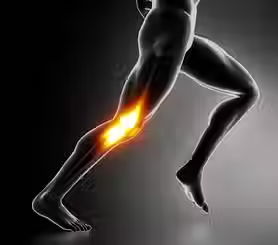
The collateral ligaments (lateral ligaments) are located across the knee joint on the outside and inside of the knee. Their function is to stabilize the knee laterally. By far the most common injuries are to the collateral ligament on the inside of the knee and often occur when there is a combination of twisting and heavy load on the knee, from the knee bending inwards during a fall, for example, or if someone runs into the outside of the knee. External collateral ligament injuries occur when there is force against the inside of the knee or if the knee is overextended under load. The vast majority of injuries to the inner collateral ligament occur near its attachment to the femur. The vast majority of injuries to the outer collateral ligament occur near its attachment to the fibula.
.avif)
Symptoms of collateral ligament injury?
Pain on the inside of the knee or pain on the outside of the knee. Initially, stiffness in both extension and bending of the knee with pain in the outer positions. Usually only slight swelling on the injured side. If the swelling is more extensive, it may be a combination injury, where the meniscus and/or cruciate ligament is also damaged. The pain is more extensive if the ligament is partially torn, compared to if it is completely torn. Depending on the degree of damage, we can see increased lateral mobility (wobble) in the knee during examination, which correlates with how much damage is to the ligament. There is also tenderness on the injured side.

Treatment for lateral ligament injury in the knee?
Immediately at the time of injury, it is a good idea to apply compression with a sturdy elastic bandage around the knee for about 30 minutes, with the knee above heart level. Then continue to apply a little lighter pressure around the knee. Rest and relieve the knee for the first day. Then gradually increase the load. How this increase in load looks depends a lot on how extensive the injury is. Here, our experienced physiotherapists can assess the extent of the injury. Rehabilitation training is started that aims to optimize coordination, mobility and load tolerance in the knee. Scar tissue is often formed in the area that must be treated. If necessary, ultrasound diagnostics can be performed as part of determining the degree of damage. The inner collateral ligament is generally not operated on. The outer collateral ligament is operated on to a greater extent.
Prognosis for a collateral ligament injury?
Ligament damage on the inside of the knee has a good prognosis with non-operative treatment, regardless of the degree of damage to the ligament.
Ligament injuries on the outside of the knee have a good prognosis with non-operative treatment and rehabilitation, as long as the ligament is not completely torn. In the case of a complete rupture, the knee is usually operated on and the ligament is stitched or stitched together. The prognosis after surgery is good, but the rehabilitation time will be longer.
Differential diagnoses for a collateral ligament injury?
On the inside of the knee, there may also be an injury to the inside meniscus, anterior cruciate ligament or pes anserinus.
On the outside of the knee, there may also be damage to the outside meniscus, iliotibial tract, biceps femoris, or damage to the ligament that holds the fibular head in place.