
Ankle sprain
Ankle sprain, what exactly is it?
Ankle sprain is the medical term for this injury. The foot has amazing mobility and function that allows us to move quickly on different surfaces. A sprain often occurs on uneven surfaces and during activities where there are rapid changes in direction. Spraining the foot is a common injury that can affect both the untrained and the elite. Over 90% of all ligament injuries occur on the outside of the ankle and most of them occur with ankle sprains. This is because the ligaments that run between the lower leg and foot on the outside of the foot are not as strong as on the inside.

What happens in the most common form of ankle sprain is that the foot turns inward (supinates) and the ligaments that run from the outer ball of the foot down to the foot are stretched and ruptured to varying degrees. Bleeding and swelling occur on the outside/front of the ankle and foot. The most common ligament that is damaged is the FTA (talofibular ligament). In a serious sprain, there is also compression of the structures on the inside of the foot, which can cause pain here as well.
Other injuries that occur with ankle sprains are peroneal injury, dislocation of a metatarsal bone (os cubiodeum) and syndesmosis fracture.
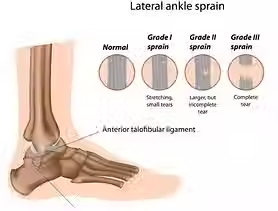
Symptoms of ankle sprain
Pain, especially on the outside of the ankle, during and after the sprain. The foot often swells and you may develop a bruise on the foot and along the outside edge of the foot from the bleeding that occurs in the damaged or ruptured ligaments. The pain from exertion makes it difficult to walk without a limp.
Treatment of ankle sprain
In an emergency, it is important to apply pressure as soon as possible in the form of a strong elastic bandage. It is advisable to place a small bandage or similar directly on the injured area and wrap it on top of it. Wrap the foot from the toes up a bit on the calf. The pressure should be so tight that after a few minutes the foot starts to hurt from the pressure. Elevate the foot (the foot should be higher than the level of the heart). Try to stand for 20 minutes and then ease the pressure slightly but continue to keep the foot elevated for a while longer. Avoid putting pressure on the foot and keep the bandage on with lighter pressure until the next day. After about a day, you can try to put pressure on the foot gently. Ice/cold can be used as it relieves pain a little, but it has no effect on the healing process. Swelling is best prevented with pressure. By managing to keep the swelling down, the healing process is accelerated.
After a few days, it is a good idea to see a physiotherapist for an examination and to investigate which structures are damaged. Often after an ankle sprain, you get scar tissue in the area that needs to be treated. We physiotherapists at Alta Vita physiotherapy know ankle sprains well and can help you start rehabilitation training at the right level and then increase the training so that you recover and minimize the risk of another sprain.

Forecast
Most people recover from a sprain. The prognosis varies depending on how extensive the damage is after the sprain. It is very important to take the time to train the stability and load tolerance of the foot after an injury like this. Otherwise, it is very easy to sprain your foot again and again and again.
If there is no improvement despite rehabilitation training and treatment, ultrasound diagnostics can be performed to see the extent of the injury. In rare cases, the patient is referred to an orthopedic surgeon for a decision on possible surgery.
